CARE Court
Quick Links
A Brief Overview Of CARE Court
Community Assistance, Recovery and Empowerment (CARE) Court is a new framework to get people with mental health and substance use disorders the support and care they need. The CARE Act is a way to allow individuals (“petitioners”) to request court-ordered treatment, services, support, and a housing plan for certain people 18+ who have untreated schizophrenia or another psychotic disorder and who meet certain health, safety, and other eligibility criteria.
CARE plans ensure participants receive a broad range of necessary services, including short-term stabilization medications, wellness and recovery supports, and connection to other social services such as housing. CARE recognizes that to serve those with the most complex behavioral health conditions, we must do the hard work of prioritizing those who need help the most, providing a comprehensive CARE plan that honors self-determination to the greatest extent possible, and holding ourselves accountable to delivering services and housing that are key to long term stability and recovery.
Pathway Through Care
Referral
Family members, behavioral health providers and first responders with a history of engagement with the individual, or other parties specified in the CARE Act may refer an individual with untreated schizophrenia spectrum or other psychotic disorder who meets specific criteria in order to prevent institutionalization and ensure appropriate care.
Clinical Evaluation
After outreach by the county, if the individual is unable to voluntarily engage in services, the court reviews the petition for evidence as to whether the individual meets the CARE criteria, and appoints legal counsel and a voluntary supporter selected by the individual if desired. The court may also order a clinical evaluation to help determine the individual’s eligibility for CARE. If the individual is determined to meet the CARE criteria, the court orders the development of a CARE plan.
Care Plan
An individualized CARE plan is developed by the county behavioral health agency, participant, participant’s legal counsel, and supporter. The CARE plan may include behavioral health treatment, stabilization medication, and a housing plan. The court reviews and adopts the CARE plan with both the participant and county behavioral health as party to the court order for up to 12 months.
Support
County behavioral health agency begins treatment to support the recovery and stability of the participant, and the court will review and update the CARE plan and associated progress during regular status hearings. The court may approve the participant to remain in the CARE plan for up to one additional year.
Success
Successful completion and graduation by the Court. Participant remains eligible for ongoing treatment, supportive services, and housing in the community to support long term recovery. The participant may elect to execute a Psychiatric Advance Directive, allowing them to document their preferences for treatment in advance of potential future mental health crisis.
Good News!
NAMI CC’s “Leave No One Behind” program has been awarded a $200,000 grant from the City of Concord (the largest city in the county) to address the needs of the Unsheltered. It is our desire to spread this approach across the county and will continue the work in Antioch (second largest city in the county) where we launched the “Leave No One Behind” program three years ago.
We’d like to hire two homeless outreach coordinators to position themselves to start addressing the needs of individuals across our county, and getting them, when appropriate, connected to Care Court. This is an effort we wish to accomplish. We want to complement the work Contra Costa County Behavioral Health is doing.
*We recognize that many of our staff members have been where these individuals are, so we know that we carry the skill set, and more importantly, the empathy and compassion, to make a difference.
Who Is Eligible To Submit A CARE Court Petition?
At NAMI CC we will be supporting family members who want to submit petitions to get their relatives treatment, but all of the following people can also submit a petition: roommates, clinicians, behavioral health departments, first responders or the respondent themselves. This last one is interesting and basically means that a peer with an untreated psychotic disorder, who wants to be connected to services and is currently not receiving them, can submit a petition for themselves.
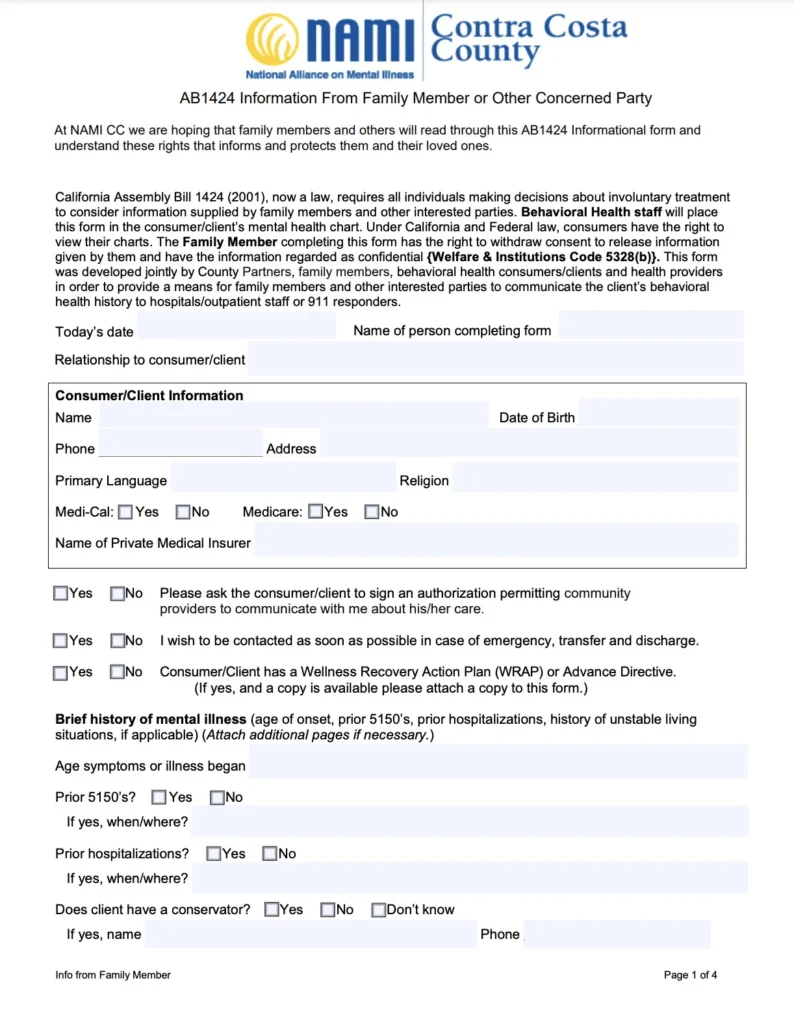
Where to Get the AB 1424 Form
At NAMI CC, we are hoping that family members and others will read through the AB1424 Informational form we provide and understand these rights that informs and protects them and their loved ones. California Assembly Bill 1424 (2001), now a law, requires all individuals making decisions about involuntary treatment to consider information supplied by family members and other interested parties. Behavioral Health staff will place this form in the consumer/client’s mental health chart. Under California and Federal law, consumers have the right to view their charts. The Family Member completing this form has the right to withdraw consent to release information given by them and have the information regarded as confidential {Welfare & Institutions Code 5328(b)}.
This form was developed jointly by County Partners, family members, behavioral health consumers/clients and health providers in order to provide a means for family members and other interested parties to communicate the client’s behavioral health history to hospitals/outpatient staff or 911 responders.
Business Hours
Where Do We Direct People Who Need Help?
We want to encourage you to start with us for the support that you may need to build a strong case for the needs not being met.
How to file a CARE-100 Form to Begin CARE Act Proceedings:
www.cchealth.org/services-and-programs/behavioral-health/care-act
The forms are listed on the page under “Resources” as CARE 100 – Petition to Commence Care Act Proceedings and CARE 100- Mental Health Declaration.
The petition is long and can be somewhat difficult for people. We can direct people who need help filling out their petition to the Superior Court’s Self-Help Center. I went to the courthouse today and met with Betty Jaw, the lawyer responsible for helping people with CARE petitions. She let me know that there are no drop-ins, but that people can make a 30 minute appointment which can be in-person or on Zoom. They will be ready to meet with people starting December 1st.
CARE Court Self-Help Center’s contact information:
Email: care_act_inquiries@contracosta.courts.ca.gov
Voicemail Line: (925) 608-2066
The Self-Help Center is a free of charge service that will help people by answering their questions, getting them started on filling out their paperwork, looking over their paperwork, and helping them file their finished petition.
Contra Costa County Care Court Contact: Behavioral Health Services Director, Suzanne Tavano: (925) 957-5169
A3 Miles Hall Community Crisis Hub Chief of Behavioral Health Crisis Services, Chad Pierce: (510) 414-6460.
For more information, here are two good resources:
Care Court’s homepage at www.chhs.ca.gov/care-act and www.courts.ca.gov/48654.htm
NAMI CC Staff Contacts for CARE Court
If you need support while you apply for your loved one to enter Care Court, please contact any of these individuals. Each individual is capable of supporting individuals across the county. However, for a loved one who spends most of their time in Antioch and Concord areas, please contact the coordinator with a service area of “Antioch.”
Olivia Henderson
(925) 765-9980
olivia.henderson@namicontracosta.org
(Elder) Desiree Rushing
(510) 206-1281
desiree.rushing@namicontracosta.org
Sheila Alarcon
(925) 942-0767
sheila.a@namicontracosta.org
Shelly Ji
(925) 765-8232
shelly@namicontracosta.org
FAQs (Frequently Asked Questions)
Downloading Petitions
Where Do I Download the Petitions?Help Filling Out Petitions
Where Can I Get Help Filling Out The Petitions?Superior Court of California, Contra Costa County Self-Help Legal Center
Email: care_act_inquiries@contracosta.courts.ca.gov
Voicemail: (925) 608-2066Superior Court of California, Contra Costa County
751 Pine Street
Martinez, CA 94553e-Filing the Petition
Can I e-file the Petition?Yes! As of December 2nd, 2024, you may e-file your petition through this link:
www.cc-courts.org/efiling/efileservices.aspx
Please be aware that while CARE Court does not charge for e-filing, the online platform used for submission may charge a small fee to submit the petition.
Physical Petition Submission
Where Do I Submit the Completed Petition?Clerk’s Office, Wakefield Taylor Courthouse
Wakefield Taylor Courthouse
Civil and Probate Clerk’s Office
Room 103
725 Court Street
Martinez, CA 94553Resources for Filling Out Petition
How Can One Learn to Fill Out the Petition?CARE Act Website: care-act.org
Contra Costa County Heath CARE Act web page: www.cchealth.org/services-and-programs/behavioral-health/care-act
Video overview on Petitioning from DHCS (Department of Health Care Services):
Video on how to fill out CARE 100 form: